
The Karnataka SSLC Mathematics exam 2026 will be conducted for 80 marks. The theory paper consists of a variety of questions, including multiple-choice questions (MCQs), very short answers, short answers, and long answers.

Table of Contents
- Karnataka SSLC Mathematics Exam Pattern 2026
- Karnataka SSLC Mathematics Unit-Wise Weightage 2026
- Karnataka SSLC Mathematics Chapter-Wise Weightage 2026
- Karnataka SSLC Mathmatics wightage 2026: Typology of Questions and Marks Allotted
- Karnataka SSLC Mathematics 2026: Types and Number of Questions from Each Chapter
- How to Score High Using Karnataka SSLC Mathematics Weightage 2026
The Karnataka SSLC Maths exam 2026 is scheduled from March 28, 2026, and will be conducted for 3 hours and 15 minutes. Students appearing for the upcoming board exam must be aware of the Karnataka SSLC Subject-wise weightage 2026 and chapter-wise weightage, as this will help them plan and study accordingly. For example, Triangles and Pair of Linear Equations in Two Variables usually carry the highest marks among other chapters, so students must prioritise this over the other chapters.
The official Karnataka SSLC Maths syllabus 2026 covers topics like Real Numbers, Polynomials, Pair of Linear Equations in Two Variables, Triangles, Coordinate Geometry, Surface Areas & Volumes, Quadratic Equations, Arithmetic Progressions, Statistics, Probability, Trigonometry, Constructions, and Areas Related to Circles. Each chapter carries specific marks based on the weightage.
The Karnataka SSLC Math exam 2026 will be conducted for 100 marks. Out of 100 marks, 80 marks will be for the theory paper, and the remaining 20 marks will be awarded from the internal assessment. The internal assessment consists of class tests, viva, practicals, assignments, and participation.
Students must score at least 33% in both the theory and internal assessment to pass the exam. Knowing the exam pattern, marking scheme, subject components, and weightage distribution helps students to manage their time effectively during preparation.
Karnataka SSLC Mathematics Exam Pattern 2026
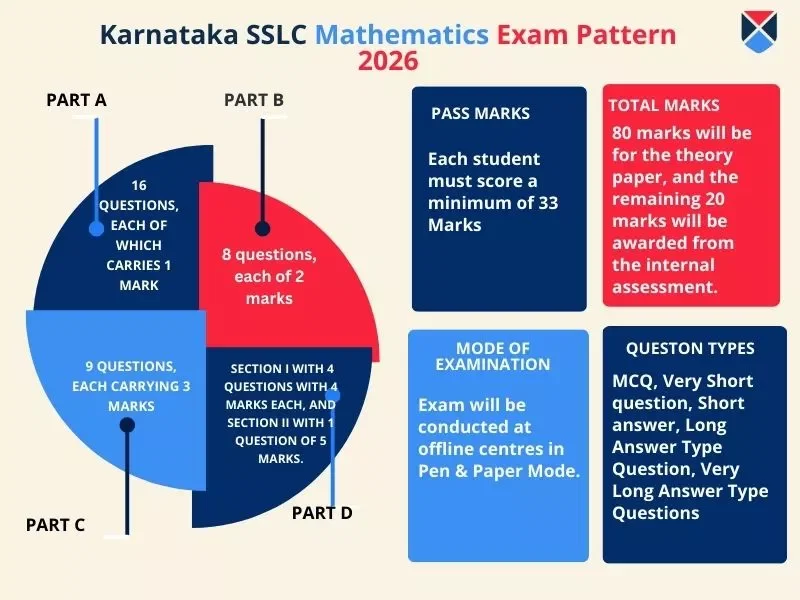
There are a total of 14 chapters in the Karnataka SSLC syllabus 2026 for Mathematics, and among them, a few important topics are Triangles, Pair of Linear Equations in Two Variables, etc. The question paper is divided into four main parts: Part A, Part B, Part C, and Part D.
- Part A: The first part consists of 16 questions, each of which carries 1 mark, and 16 marks from this part.
- Part B: This part included 8 questions, each of 2 marks, and a total of 16 marks from this part.
- Part C: Part C has 9 questions, each carrying 3 marks. So, a total of 27 marks from this part.
- Part D: The last part is divided into two sections, Section I with 4 questions with 4 marks each, and Section II with 1 question of 5 marks. So, a total of 21 from this part.
In total, there are 38 questions in the paper, and students must answer them according to the patterns or as directed.
Karnataka SSLC Mathematics Unit-Wise Weightage 2026
Students can check below the expected unit-wise breakdown of marks for the Karnataka SSLC Class 10 Mathematics exam 2026. The distribution is based on the latest Karnataka SSLC Mathematics exam pattern 2026 and blueprint, curated by the Karnataka School Examination and Assessment Board (KSEAB).
Among all the units, Algebra, Geometry, and Trigonometry generally carry higher weightage in the Karnataka SSLC Mathematics exam. Students must focus more on important topics such as quadratic equations, triangle properties, trigonometric identities, and applications of trigonometry. Units like Statistics, Probability, Mensuration, and Coordinate Geometry also play an important role and help students score easily through formula-based and calculation-oriented questions.
| Unit Name | Total Marks | Weightage |
| Arithmetic (Real Numbers, Progressions, Commercial Mathematics) | 12 | 15% |
| Algebra (Polynomials, Linear Equations, Quadratic Equations, Pair of Linear Equations) | 16 | 20% |
| Trigonometry (Trigonometric Ratios, Identities, Heights and Distances) | 14 | 18% |
| Coordinate Geometry | 8 | 10% |
| Geometry (Triangles, Circles, Constructions) | 14 | 18% |
| Mensuration (Surface Areas and Volumes) | 8 | 10% |
| Statistics and Probability | 8 | 10% |
| Total | 80 | 100% |
Karnataka SSLC Mathematics Chapter-Wise Weightage 2026
Students who are appearing for the Karnataka SSLC exam 2026 for Mathematics must know the chapter-wise marks distribution. The chapter-wise weightage helps students focus on high-scoring topics and prepare more effectively for the Karnataka SSLC Mathematics exam 2026.
The following table provides an approximate marks distribution based on the Karnataka SSLC Maths syllabus and previous exam trends.
| Chapter Name | Marks |
| Triangles | 9 |
| Pair of Linear equations in two variables | 8 |
| Surface areas and volumes | 7 |
| Statistics | 4 |
| Quadratic equations | 6 |
| Polynomial | 5 |
| Arithmetic Progression | 8 |
| Introduction to Trigonometry | 6 |
| Circle | 5 |
| Coordinate Geometry | 6 |
| Real numbers | 5 |
| Some Applications of Trigonometry | 4 |
| Probability | 4 |
| Area Related to Circles | 3 |
| Total | 80 |
Karnataka SSLC Mathmatics wightage 2026: Typology of Questions and Marks Allotted
As per the Karnataka SSLC exam pattern 2026, the Mathematics theory paper is conducted for 80 marks, and the question paper consists of different types of objective and subjective questions. The remaining 20 marks are awarded through internal assessment based on assignments, projects, and classroom performance.
| Type of Question | Total Number of Questions | Marks per Question | Total Marks |
| MCQs | 16 | 1 | 16 |
| Very Short question | 8 | 2 | 16 |
| Short answer | 9 | 3 | 27 |
| Long Answer Type Question | 4 | 4 | 16 |
| Very Long Answer Type Questions | 1 | 5 | 5 |
| Total | 80 | ||
Karnataka SSLC Mathematics 2026: Types and Number of Questions from Each Chapter
According to the Blueprint of SSLC 2026 Karnataka Maths, the question paper for the Maths exam will consist of 8 MCQ-type questions, 8 very short answer questions worth 1 mark each, 8 short answer-type questions worth 2 marks each, 9 long answer-type questions worth 3 marks each, 2 long answer-type questions worth 4 marks each, and 1 long answer-type question worth 5 marks.
Candidates who will appear for the exam must know the chapter-wise weightage and the number of questions that will come in the exam from each chapter. Here is a detailed breakdown and marks distribution among different chapters:
| Name of the Chapter | 1 Mark Question | 2 Mark Question | 3 Mark Question | 4 Mark Question | 5 Mark Question | No. of Questions | Marks Allotted |
| Triangles | 2 | - | 1 | 1 | - | 4 | 9 |
| Pair of Linear equations in two variables | 2 | 1 | - | 1 | - | 4 | 8 |
| Surface areas and volumes | 2 | - | - | - | 1 | 3 | 7 |
| Statistics | 1 | - | 1 | - | - | 2 | 4 |
| Quadratic equations | |||||||
| Polynomial | 2 | - | 1 | - | - | 3 | 5 |
| Arithmetic Progression | 2 | 1 | - | 1 | - | 4 | 8 |
| Introduction to Trigonometry | 1 | 1 | 1 | - | - | 3 | 6 |
| Circle | - | 1 | 1 | - | - | 2 | 5 |
| Coordinate Geometry | 1 | 1 | 1 | - | - | 3 | 6 |
| Real numbers | 1 | 2 | - | - | - | 3 | 5 |
| Some Applications of Trigonometry | - | - | - | 1 | - | 1 | 4 |
| Probability | 1 | - | 1 | - | - | 2 | 4 |
| Area Related to Circles | - | - | 1 | - | - | 1 | 3 |
| Total | 16 | 8 | 9 | 4 | 1 | 38 | 80 |
How to Score High Using Karnataka SSLC Mathematics Weightage 2026
Candidates who will appear for the Karnataka SSLC exam must know that the studying pattern for each subject is different, and similarly, mathematics is a technical subject, so they must know the correct method of studying, practising and revising it before the exam.
- Students must be thorough with the syllabus and chapter-wise mark distribution, as this will help them to prioritise the most important and weighted chapters over less important chapters.
- Thereafter, prepare a proper schedule and try to practise mathematics every day for at least 1.5 hours.
- Make a short note and write all the formulae chapter-wise, as this will help while solving the problems and for a quick revision.
- Candidates must not forget to practise the sample papers and previous years' papers, as this will improve their fluency while solving the questions.
- You should note down the mistakes that you’re frequently committing and try to avoid and rectify them after you solve any problem next time.
The above-mentioned unit-wise and chapter-wise breakdown of marks will help the students in planning their preparation. The most weighted chapters include Triangles, Pair of Linear equations in two variables, etc. So, students must plan their studies keeping in mind the chapter-wise weightage. You must regularly practise questions as this will increase your confidence and problem-solving ability.











POST YOUR COMMENT